
Mathematics
Explore Mathematics at CJC, from H1 to H3 levels, and discover enrichment programmes, competitions, and stretch opportunities designed to deepen your skills and passion for the subject.
video to be embedded here
Microlesson
video to be embedded here
Programmes/Achievements
Testimonials
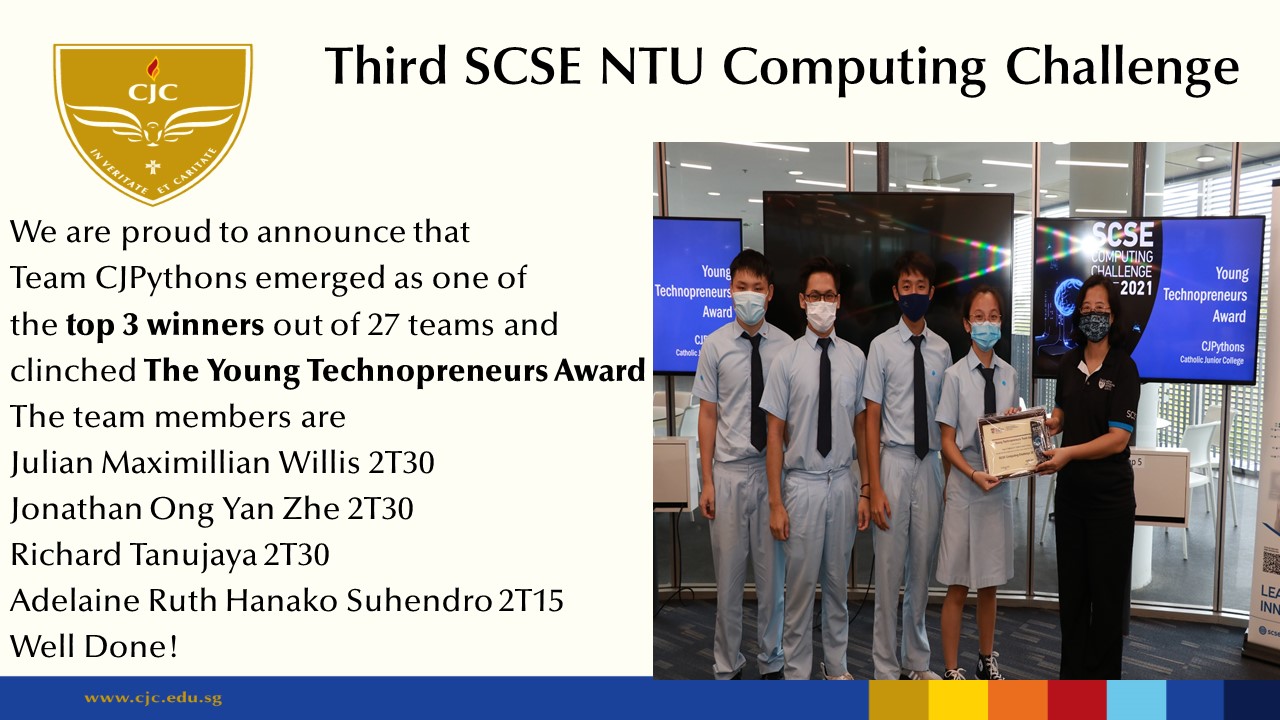
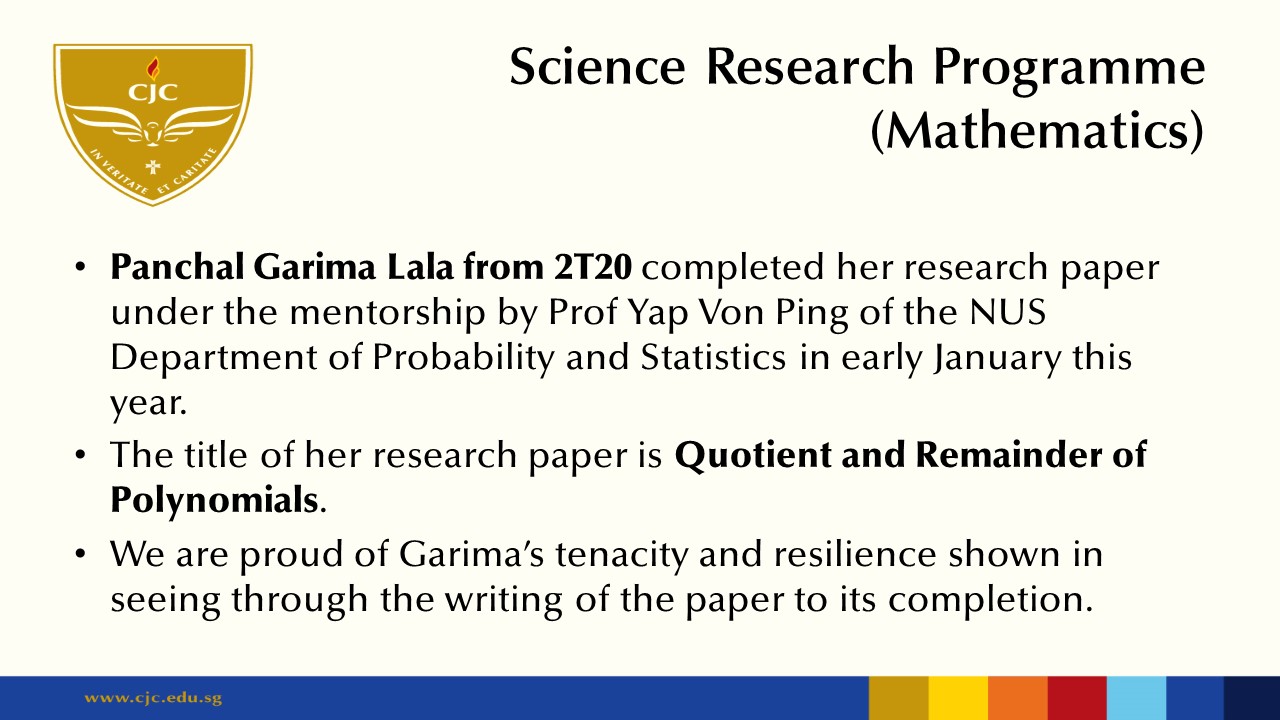
We participated in the School of Computer Science and Engineering Challenge 2021. It was a month long competition where we were presented with a data science and artificial intelligence problem and were required to code a machine learning model to solve the problem.
It was definitely one of the most enriching and eye-opening experience throughout my time in CJC. This competition has definitely widened our knowledge on data science and AI and moreover, I have learnt to embrace the spirit of perseverance and community in the midst of challenges. I am also grateful for having forged meaningful friendships throughout this period and on this note, i’d like to thank my teammates for putting in their best effort and at the same time making this competition a fun and memorable experience.
We’d like to thank the school for giving us this amazing opportunity to take part in this competition. We’re pleased to say that our team has emerged as the top 3 teams out of 30 teams from the different junior colleges and was awarded the Young Technopreneur Award.
Adelaine, 2T15, Richard, Jonathan and Julian,all 2T30
Purpose of studying Mathematics at A-Level
Learning Mathematics is optional at A-Level. However, it is offered by almost all students. The purpose of learning Mathematics at A-Level is two-fold. Firstly, it provides students, regardless of the intended course of study at the University, with a useful set of tools and analytical skills to support not just tertiary study but also to sharpen their problem solving skills. Secondly, learning mathematics exposes students to a way of thinking that complements other ways of thinking developed through the other disciplines.
Skills
The CJC Mathematics department aims to nurture effective problem solvers and critical thinkers based on the Singapore Mathematics Framework:
Understanding and applying mathematical concepts and skills in a variety of contexts, including the manipulation of mathematical expressions and the use of graphing calculators
Reasoning and communicating mathematically through writing mathematical explanations, arguments and proofs, and inferences
Solving unfamiliar problems; translate common realistic contexts into mathematics; interpret and evaluate mathematical results, and use the results to make predictions, or comment on the context
Difference between Mathematics at A- and O-Levels
In secondary schools, all students learn O-Level Mathematics while students with an aptitude and interest in mathematics also offer Additional Mathematics. The learning of Mathematics at the A-Level builds on students’ prior knowledge and skills in O-Level Mathematics and Additional Mathematics.
To cater to the diverse needs, interests, and abilities of students, we offer the following 3 syllabuses:
H1 Mathematics;
H2 Mathematics and
H3 Mathematics
O-Level Mathematics provides the assumed knowledge for H1 Mathematics while H2 Mathematics assumes some of the content covered in Additional Mathematics. H3 Mathematics is an extension of H2 Mathematics in terms of higher-order problem solving skills.
Assessment in the new Curriculum
Broadly speaking, students will be assessed on three levels:
Understanding and applying mathematical or statistical concepts and skills in a variety of problems including those that may be set in unfamiliar context or require integration of concepts and skills from more than one topic;
Formulating real-world problems mathematically, solve the mathematical problems, interpret and evaluate the mathematical solutions in the context of the problems; and
Reasoning and communicating mathematically through making deductions and writing mathematical explanations, arguments of varying rigour, and proofs.
Curriculum
H1 Mathematics (8865) Revised Syllabus for 2016 onward
To provide students with a foundation in mathematics and statistics.
It is particularly appropriate for students without an Additional Mathematics background because it offers an opportunity for them to learn important mathematical concepts and skills in algebra and calculus that are covered in Additional Mathematics.
H2 Mathematics (9758) Revised Syllabus for 2016 onward
To prepare students for a range of university courses, including mathematics, sciences and related courses, where a good foundation in mathematics is required.
It develops mathematical thinking and reasoning skills that are essential for further learning of mathematics.
Through the applications of mathematics, students also develop an appreciation of mathematics and its connections to other disciplines and to the real world.
Assessment
H1 Mathematics (8865) Revised Syllabus for 2016 onward
One 3-hour paper marked out of 100
- Section A (Pure Mathematics – 40 marks)
- Section B (Probability and Statistics – 60 marks).
Examination questions may integrate ideas from more than one topic, and topics may be tested in the contexts of problem solving and application of mathematics.
H2 Mathematics (9758) Revised Syllabus for 2016 onward
Two 3-hour papers, each carrying 50% of the total mark, and each marked out of 100.
Paper 1 (3 hours):
Only the Pure Mathematics section of the syllabus (100 marks)Paper 2 (3 hours):
- Section A (Pure Mathematics – 40 marks)
- Section B (Probability and Statistics – 60 marks)
Examination questions may integrate ideas from more than one topic, and topics may be tested in the contexts of problem solving and application of mathematics.
H3 Mathematics (9820) Revised Syllabus for 2016 onward
H3 Mathematics offers students who have a strong aptitude for, and are passionate about mathematics, an opportunity to further develop their mathematical modeling and reasoning skills. The syllabus aims to enable students who have an aptitude and passion for mathematics to:
acquire advanced mathematical concepts and skills to deepen their understanding of mathematics, and to widen the scope of applications of mathematics
develop rigorous habits of mind through mathematical reasoning and proof, creative mathematical problem solving, and use of mathematical models
connect ideas within mathematics at a higher level and between mathematics and other disciplines through applications of mathematics
appreciate the beauty, rigour and abstraction of mathematics through mathematical proof and applications
Programme available
Students may pursue the H3 Mathematics programme jointly offered by NUS, NIE and MOE.
Assessment
One 3-hour paper, marked out of 100.
Topic Overview
Numbers, e.g. primes, co-primes, divisibility, modulo arithmetic, greatest common divisor, division algorithm;
Functions, e.g. graphs, symmetries, derivatives, integrals, differential equations, limiting behaviours, bounds;
Sequences and series, e.g. general terms, sum, limiting behaviours, bounds;
Inequalities, e.g. AM-GM inequality, Cauchy-Schwarz inequality, triangle inequality;
Counting, e.g. distribution problems, Stirling numbers of the second kind, recurrence equations, bijection principle, principle of inclusion and exclusion.
H3 Mathematics is to be studied together with H2 Mathematics.
Students are selected for H3 Mathematics at the end of JC1, based on their performance throughout the year, including the end-of-year examination and possible selection tests.
Frequently Asked Questions
1. Should I do H1 or H2 Mathematics?
You should consider H2 Mathematics if you
are interested in science, strong in Mathematics and offer mathematics because it supports your future in science (excluding biological sciences).
OR
are generally strong in mathematics, but prefer a non-science-based course and intend to offer mathematics as a contrasting subject.
You should consider H1 Mathematics if you
are more inclined towards the arts and humanities;
intend to offer Mathematics as a contrasting subject;
intend to pursue business, social sciences or biological sciences at the university;
have no Additional Mathematics background
2. If I have no Additional Mathematics background, can I still take H2 Mathematics?
If you are very clear of the purpose of taking H2 mathematics, you can still take H2 Mathematics provided you meet the college merit-based criteria (please refer to the subject combination section). You must be prepared to spend more time outside curriculum time to do the catching up. You must also consider the time needed for other subjects who are new to you, such as General Paper and Project Work.
3. What is this Graphing Calculator?
Essentially, a graphing calculator (GC) is a learning tool that is designed to help students visualize and better understand concepts in mathematics and science, and the use of a GC is expected for H1, H2 & H3 Mathematics. Examination papers will be set with the assumption that candidates will have access to a GC. The college uses the model by Texas Instruments.
Academic Enrichment Section
CJC MATHEMATICS DEPARTMENT
STRETCH PROGRAMMES
“Success is no longer about reproducing content knowledge, but about extrapolating from what we know and applying that knowledge to novel situations.”
Andreas Schleicher, head of OECD PISA
We believe in maximising the potential of every student and offer intellectually stimulating learning experiences for students who are ready to go deeper and further in the subject, thereby igniting a passion in them and preparing them for a digital future.
The stretch programmes target mainly the science students pursuing H2 Mathematics.
The department offers a suite of co-curricular programmes that cater to students of diverse talents and interests:
Mathematics co-curricular programmes by tier and target group
Tier Talent | Target Group Selected students | Opportunities
|
|
|
|
Core | Open to all interested students |
|
Our Partners include A*STAR, Lee Kuan Yew School of Public Policy, Mathematical Modelling Singapore, Cyber Security Agency Singapore, IMDA, Science Centre Singapore, Texas Instruments, NUS, NTU, and SMU.
The following are our niche programmes:
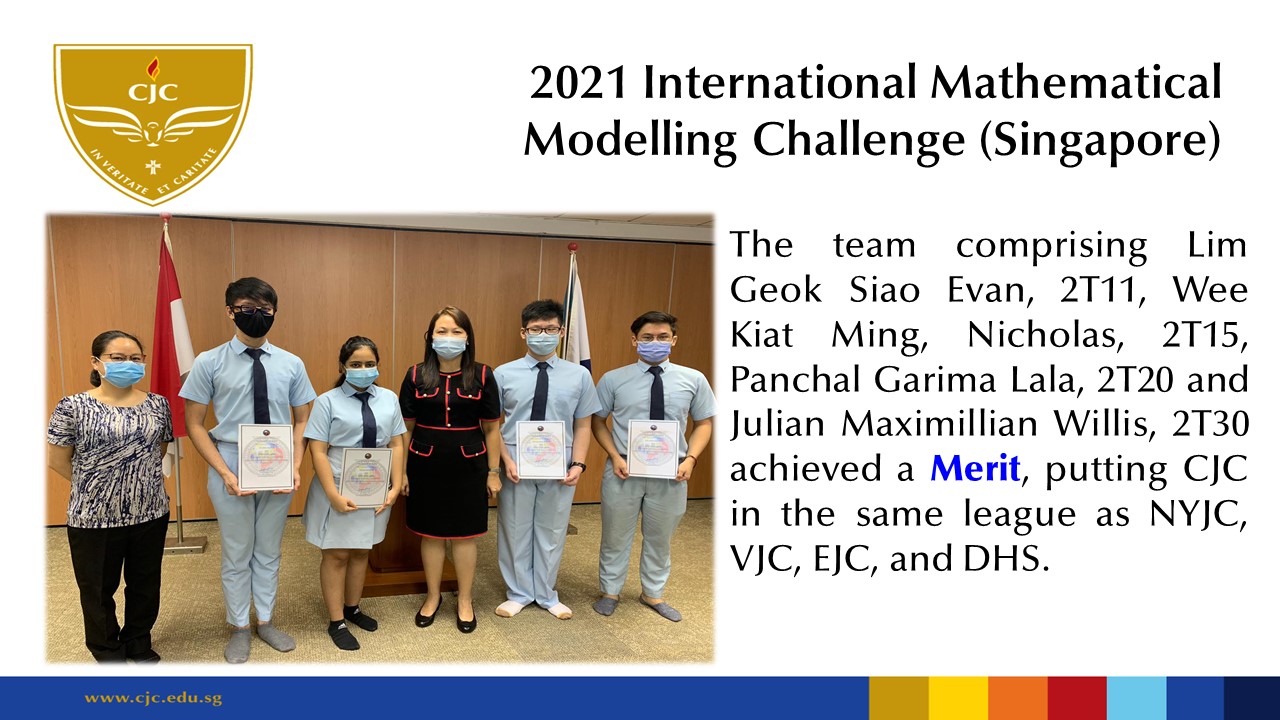
International Mathematical Modelling Challenge
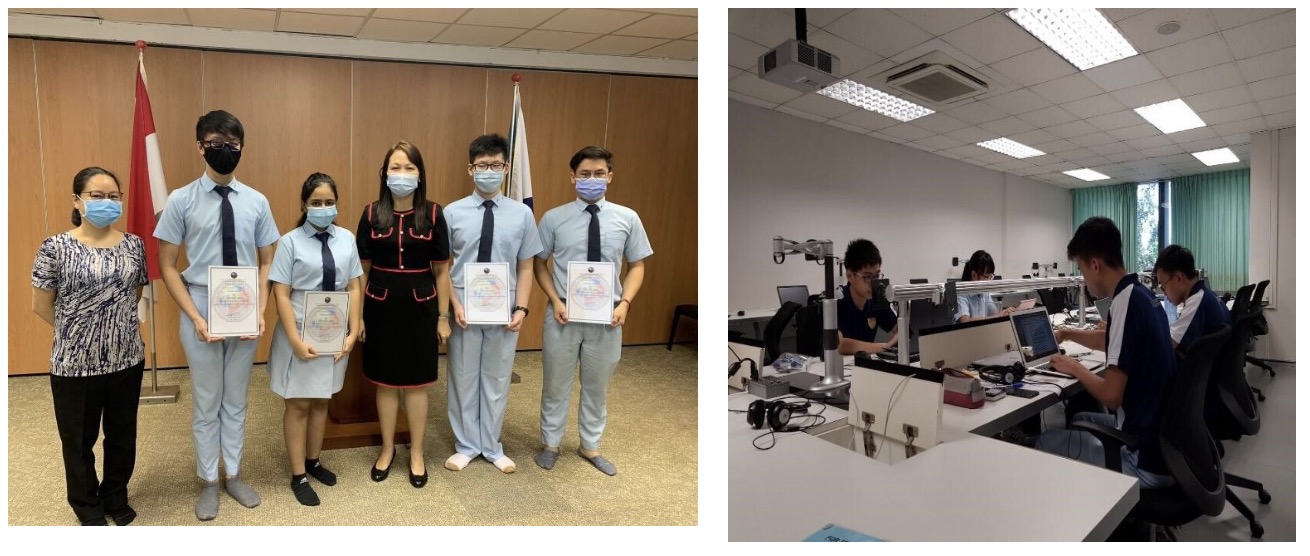
Organised by Mathematical Modelling Singapore, the Challenge seeks to promote the teaching of mathematical modelling and applications of mathematics to all ages. This is based on the belief that the use of mathematics is helpful to better understand, analyze and solve real-life problems that are seemingly not related to mathematics.
Participants of this competition are shortlisted based on their JC1 performance and recommendation from tutors. The shortlisted students are mentored by a teacher advisor who will prepare them for the challenge.
WOW Factor: Real world problems require students to integrate knowledge from different topics of mathematics for their analysis and solution. And real problems take time and teamwork. The IM2C provides students with a deeper experience both of how mathematics can explain our world and what working with mathematics looks like. The participants have to be resourceful, do independent research as well as work closely as a team. One of the team members must have knowledge of Python programming. Students also have the opportunity to hone their Scientific Report Summary writing skills.
Data Science Competition
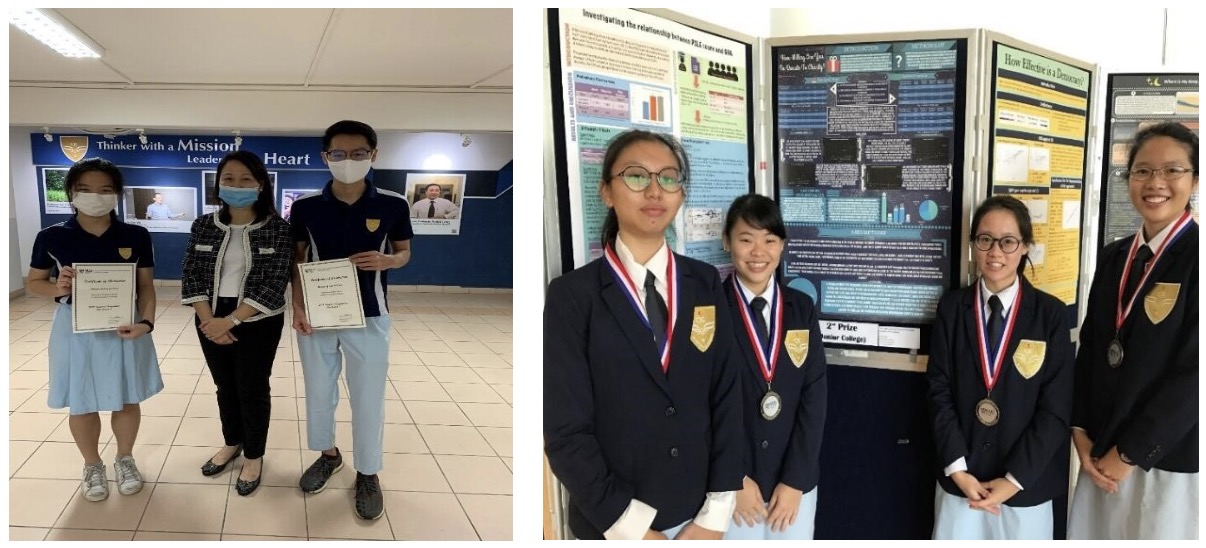
This is a team-based competition open to students in their second year. Organized by the Department of Statistics and Applied Probability of the NUS, the annual competition encourages students to explore creative data displays.
WOW Factor: Mentored by a tutor, participants are challenged to apply research skills and perform statistical analysis using concepts that they learnt from H2 Maths as well as H2 Further Maths to create a poster of an authentic social issue of their interest. Students also have the opportunity to hone their skills in data collection, statistical report writing, and design.
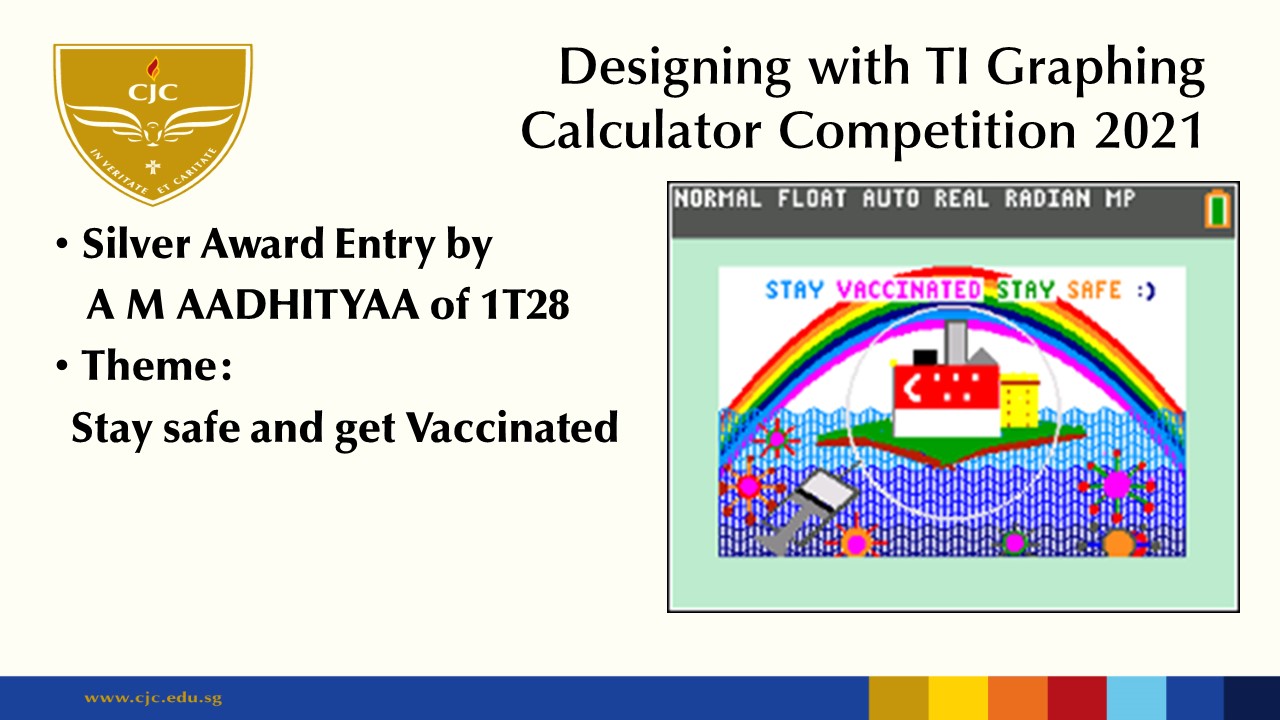
Design using Graphing Calculator Competition
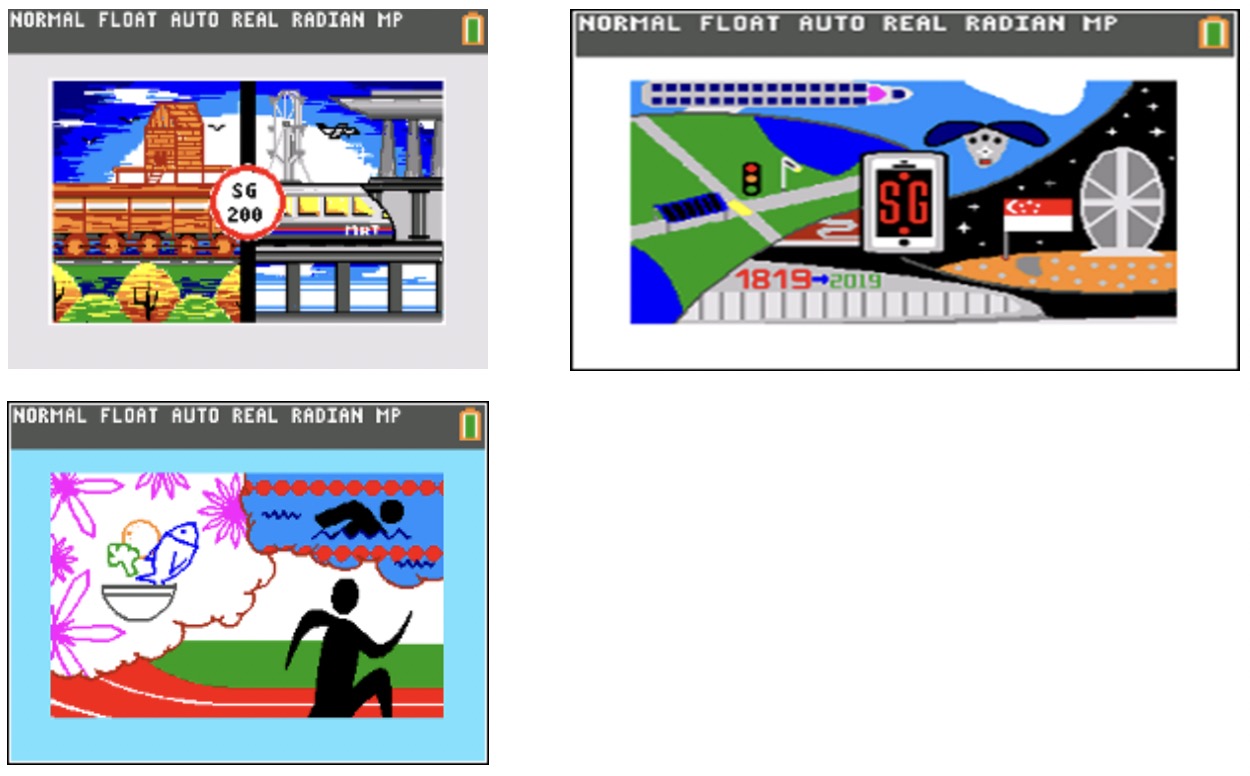
The competition is open to all students studying in a Junior College / Centralised Institute or a Secondary School in Singapore or the equivalent in Malaysia.
WOW Factor: Participants are challenged to do independent research and use the Texas Instruments Graphing Calculator to create artwork based on a theme. They get to appreciate how to apply knowledge of the different graphs of H2 Maths and Further Maths to design!
Head of Department: Mr Lim Chye Fook (opens in new tab)
Level Head: Ms Chia Shing-Li (opens in new tab)
Level Head: Mr Kam Wei Loon (opens in new tab)